The Big Prediction
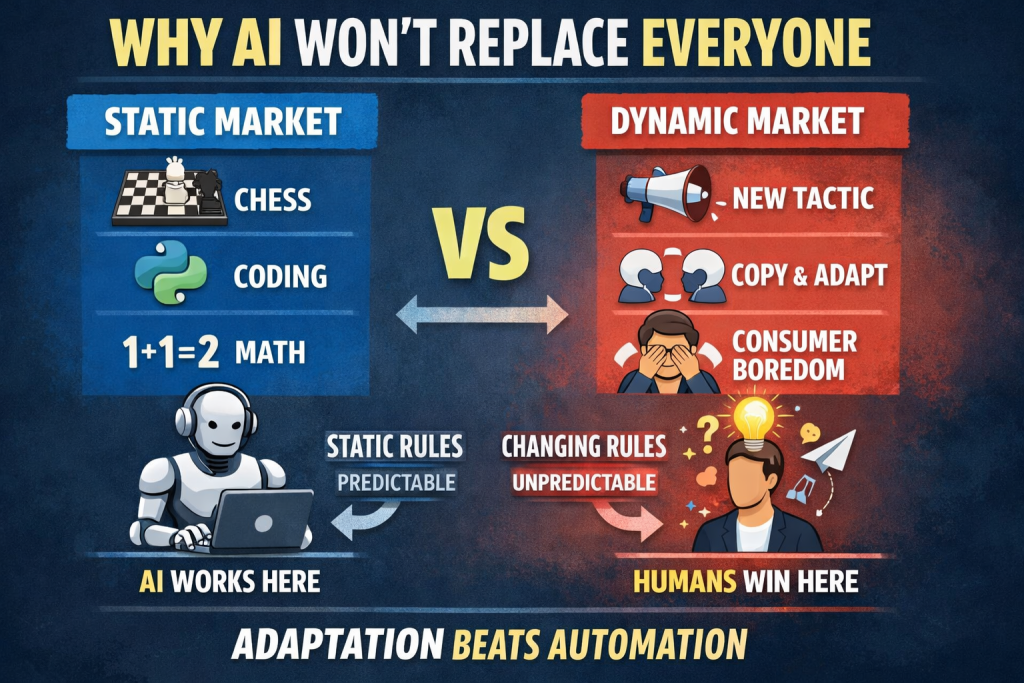
There’s a growing belief in parts of the tech world that artificial intelligence is on the verge of replacing most human jobs. Some argue we have only 12–18 months before automation takes over large portions of knowledge work. According to this view, AI models are now intelligent enough to outperform humans across industries.
But this prediction rests on a flawed assumption. It assumes that all work operates inside a static system one where the rules stay the same and optimisation is the only challenge. That’s not how most human-centred industries function. The confusion lies in mixing up static markets with dynamic markets.
What Is a Static Market?
A static system has fixed rules. The environment does not change based on the participants’ behaviour.
Consider a few examples:
- Coding: Programming languages follow stable syntax rules. Python does not change its grammar because a developer feels creative or bored.
- Chess: The board always has 64 squares. The rules never shift mid-game. AI surpassed human champions because the system is bounded and consistent.
- Mathematics: The logic is absolute. 1 + 1 will always equal 2.
In static environments, AI thrives. It can analyse massive datasets, calculate optimal strategies, and produce near-perfect outputs because the framework remains stable. Optimisation works when the target doesn’t move.
Marketing Is Not a Chessboard
Now consider marketing. Many assume marketing is simply a data problem: feed enough consumer information into a large language model, craft the right prompts, and it will generate the “perfect” ad, the “perfect” email, the “perfect” hook. This logic treats marketing like math. But marketing is not math. Marketing behaves more like a living organism.
The Nature of Dynamic Markets
In a dynamic market, the rules change because people react.
When a new marketing strategy works, competitors copy it.
When everyone copies it, consumers adapt.
When consumers adapt, the tactic loses its power.
What was once novel becomes invisible. Think about the first time you saw a pop-up ad. It grabbed your attention. It felt disruptive. Today, you close them without thinking. The effectiveness declined not because the format changed technically, but because people changed. Dynamic systems evolve in response to participation. And that is the key difference.
AI Is an Averaging Machine
Artificial intelligence is fundamentally a prediction engine. It is trained on past data. It identifies patterns and produces statistically probable outputs. In other words, AI generates what is expected. That’s its strength and its limitation. In static systems, expected outcomes are valuable. In dynamic markets, expected outcomes are ignored. Because in marketing, doing what is predictable often guarantees failure.
The Human Edge
Human creativity does not just optimise existing patterns; it breaks them. Humans introduce surprise, cultural nuance, emotional timing, and risk. We respond to shifts in mood, context, and social dynamics in ways that are difficult to reduce to historical averages.
Dynamic markets reward originality, not conformity. As AI-generated content becomes more common, predictability will increase. And when predictability increases, attention decreases. The more average the output, the less impact it has. Ironically, the widespread adoption of AI in creative industries may increase the value of distinctly human thinking.
The Real Future
This doesn’t mean AI won’t change work. It will. It will automate repetitive tasks, enhance productivity, and lower the barrier to entry in many fields. But replacing all human contribution, especially in dynamic, adaptive markets, is far more complex than many assume. The mistake is not overestimating AI’s intelligence. The mistake is underestimating how human systems evolve. In static worlds, optimisation wins. In dynamic worlds, adaptation wins. And adaptation is not just about predicting the future. It’s about changing it.