Bertrand Russell was a renowned mathematician, logician, philosopher, and social critic, best known for works such as Principia Mathematica, The Problems of Philosophy, Why I Am Not a Christian, and Why I Am Not a Communist. Although trained in mathematics and logic, Russell consistently applied rational and scientific thinking to religion, morality, and politics. In his famous essay “Why I Am Not a Christian,” Russell explains the philosophical and moral reasons for rejecting Christianity.
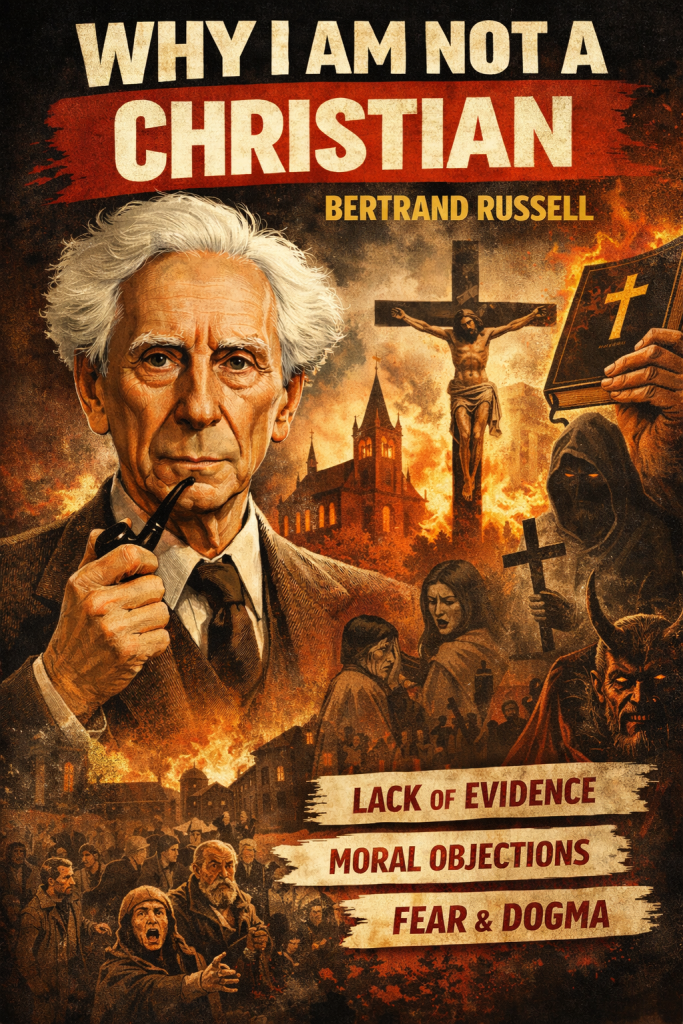
Russell begins by clarifying what he means by the word Christian. According to him, a Christian is someone who believes in God and immortality and regards Christ as the best and wisest of men. Russell rejects Christianity because he does not accept these beliefs. His rejection is not emotional or hostile, but based on reason and evidence.
A major part of the essay is devoted to criticising the traditional arguments for the existence of God. Russell examines the First Cause Argument, which claims that everything must have a cause and therefore God must be the first cause. He argues that if everything needs a cause, then God should also need one; and if something can exist without a cause, the universe itself could exist without God. He also rejects the Natural Law Argument, stating that scientific laws are descriptions of how things behave, not commands imposed by a divine lawgiver. The Design Argument, which suggests that order in the universe proves a designer, is dismissed by Russell on the grounds of evolution and natural selection.
Russell then turns to the moral character of Christ. While he acknowledges some admirable teachings of Jesus, such as compassion and kindness, Russell criticizes the doctrine of eternal punishment (hell). He believes that a truly moral person would not threaten people with everlasting suffering. For Russell, this idea contradicts the claim that Christ represents the highest moral ideal.
Another important criticism in the essay is Russell’s view that religion is based largely on fear, fear of death, fear of the unknown, and fear of punishment. He argues that religion discourages free inquiry and independent thinking, which are essential for intellectual and moral progress. According to Russell, religion has historically opposed scientific advancement and has often justified cruelty, intolerance, and oppression.
Russell also rejects the idea that morality depends on religion. He believes that moral values arise from human sympathy, reason, and the desire to reduce suffering. In his view, ethical behaviour does not require belief in God, and secular morality can be more humane and flexible than religious morality.
In conclusion, Russell states that he is not a Christian because Christianity lacks logical proof, relies on fear, and contains moral teachings he finds unacceptable. He advocates a world guided by reason, science, and human compassion rather than faith and dogma. His essay is not merely an attack on Christianity but a powerful defence of free thought and rational inquiry, making it one of the most influential critiques of religion in modern philosophy.